
What are business electricity plans in Australia?
By Michael Koopman, Co-founder and CEO. Updated 29 September 2026.
Compare business electricity plans in Australia. See plan types, DMO or VDO checks, and how Termina reviews rates without guaranteed savings.

Business electricity plans are retailer contracts that set how a commercial site is billed for usage, supply, and other pass-through costs. They can be standing offers or market contracts, with terms that fit a single cafe or a multi-site portfolio. Termina helps SMEs and commercial buyers compare those plans across retailers, then keep reviewing them after you switch. No provider can guarantee savings.
In participating jurisdictions, Energy Made Easy is the free government comparison service for eligible households and small businesses. Service NSW notes it covers NSW, ACT, Queensland, South Australia and Tasmania under the National Energy Customer Framework. Victoria uses the Victorian Default Offer as a standing-offer benchmark. For commission-free procurement, see Termina’s procurement overview or get a savings estimate.
What types of business electricity plans exist?
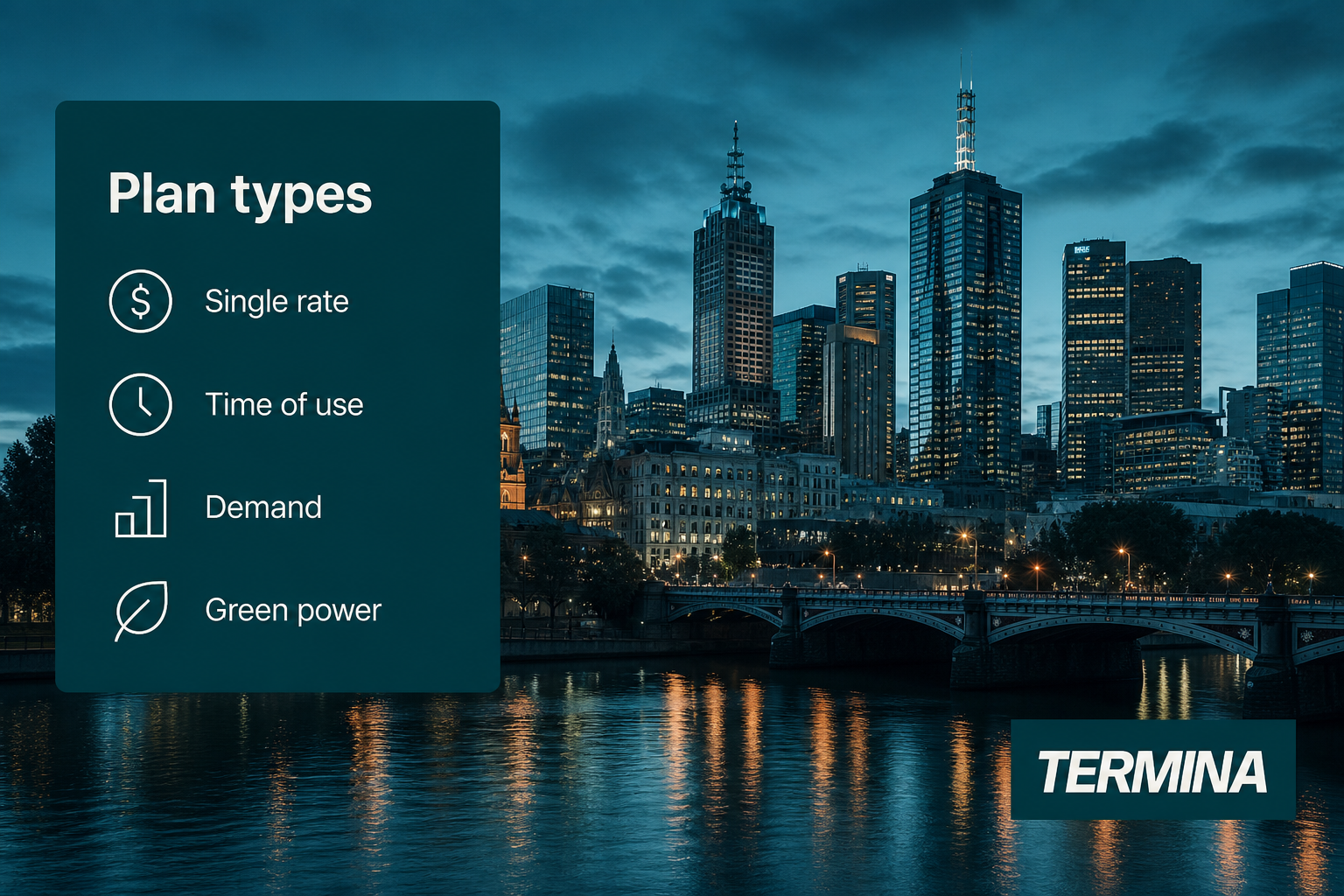
Most business electricity plans sit on a single-rate, time-of-use, or demand-style tariff, sometimes with a green-power option. Standing offers follow default-price rules in some regions. Market plans are retailer-set and can look cheaper on usage while costing more on supply or contract conditions.
The right type depends on when you use power, not only how many kWh you use. A restaurant with evening peaks and a warehouse with daytime load should not copy each other’s plan. Treat any labelled chart as illustrative until it matches 12 months of your bills.
How do you compare business electricity plans fairly?
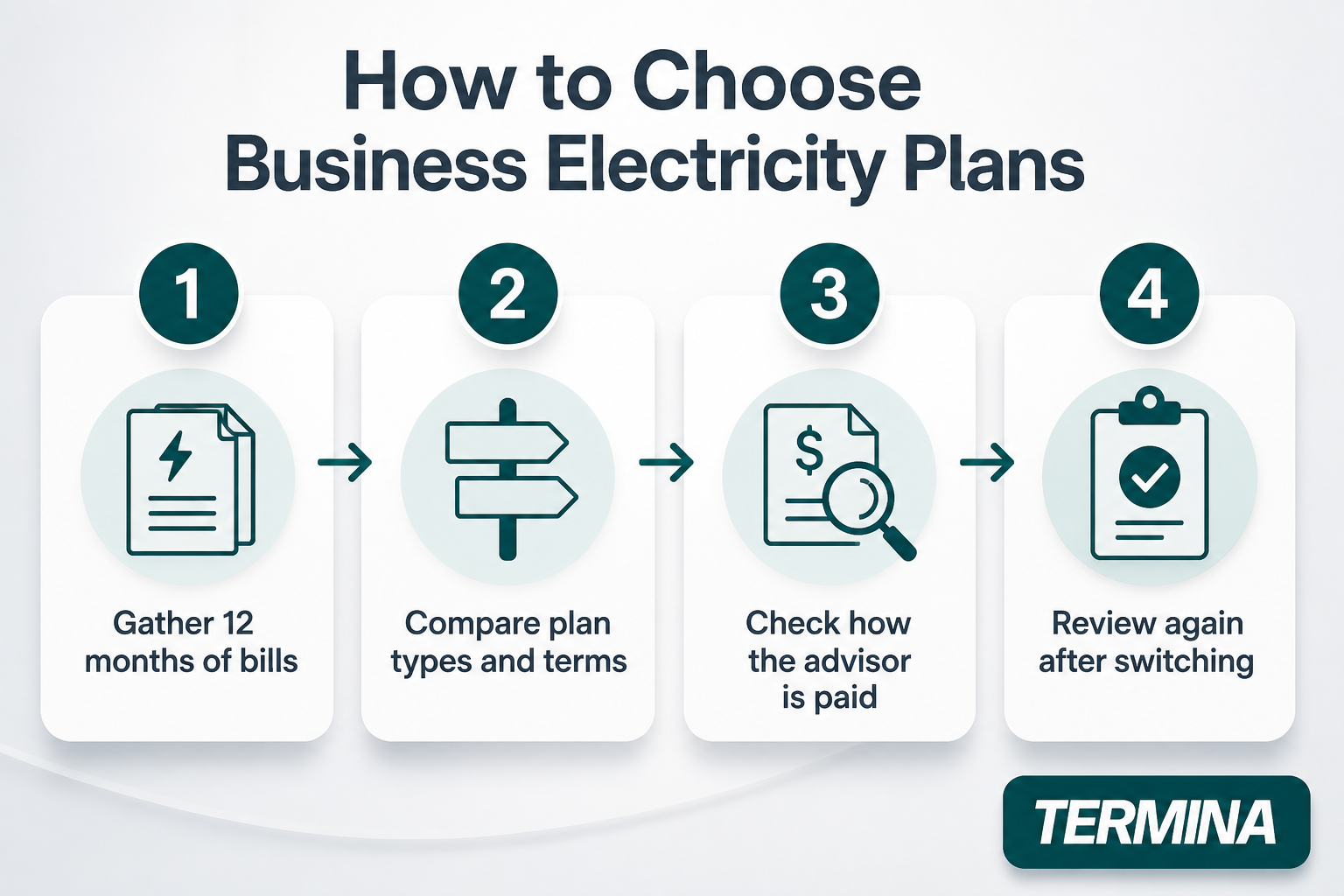
Compare estimated annual cost on your actual usage, including supply charges, demand items, discounts, and exit or rollover clauses. Check DMO or VDO where they apply, then look at market offers. Ask in writing how any broker or platform is paid before you sign a Letter of Authority.
Energy Made Easy suits eligible single-site DIY compares. Choice Energy is a fair commercial broker that runs retailer tenders. Termina states on pricing that it refuses retailer commissions and earns from a share of documented savings when it runs procurement. None of these paths guarantees a lower bill.
- Energy Made Easy: best for one eligible site when you will switch yourself. Watch-out: you own renewals.
- Retailer direct: best for a simple one-site quote. Watch-out: you may not see the full market.
- Traditional broker: best when you need a tender. Watch-out: ask how commissions work.
- Termina: best for multi-site portfolios or ongoing review. Watch-out: savings are not guaranteed.
- Stay put: best when the current plan already looks competitive. Watch-out: benefit periods can expire.
Who should use which path for business electricity plans?
Single-site owners with time to self-serve can start on Energy Made Easy in NECF states. Multi-site, franchise, or high-admin portfolios usually need a broker or platform that can hold contracts and bills in one place. New Zealand sites sit outside Australian comparison tools, so compare those bills on local retailer terms.
If you run retail, hospitality, or manufacturing loads, match the plan to operating hours. Do not copy one headline cents-per-kWh figure across states or countries.
When should you switch business electricity plans?
Review when a benefit period ends, a standing offer looks high versus DMO or VDO, you add sites, or wholesale conditions have shifted. Waiting for auto-renewal is a common way a once-competitive plan drifts. Past savings on other sites are not a forecast for yours.
Pull 12 months of invoices, your NMI, and the contract end date first. Then compare. Wholesale context on the Termina blog can help with timing, but retail plans still include network and other costs.
Why use Termina for business electricity plans?
Termina is built for commercial and multi-site buyers in Australia and New Zealand who want commission-free comparison plus ongoing review, not a one-off quote. Pair that with bill consolidation so finance can see the landed cost across every site. Advisors can refer clients through the partners program.
- Upload recent bills for a Termina savings estimate
- Compare plan type, term, and full landed cost
- Switch only after you confirm the assumptions
- Keep reviewing after the switch so the plan does not drift
Accountants and advisors can refer clients through Termina partners.
Frequently asked questions
Are business electricity plans the same as household plans?
No. Business plans often have different supply charges, demand or time-of-use structures, and eligibility rules. Small-business standing offers may sit under DMO or VDO in some regions. Larger sites usually sit outside those small-customer defaults.
Where can I compare business electricity plans for free?
Energy Made Easy is the AER’s free comparison site for eligible customers in NSW, Queensland, South Australia, Tasmania and the ACT. Victoria has its own comparison tools and the VDO. WA and NT buyers typically go to retailers or a broker.
Does a cheaper usage rate mean a better plan?
No. A low cents-per-kWh figure can sit next to a high daily supply charge, demand charges, or a poor fit for your load shape. Compare estimated annual cost on your actual usage.
Can Termina guarantee a cheaper business electricity plan?
No. Termina can tender the retailer market and keep reviewing offers. Results depend on your load, network, contract timing, and retailer pricing. Historical portfolio outcomes are not a guarantee for your sites.
Should I use a broker or Termina?
Use a broker or platform when you lack time, have multiple sites, or need tenders beyond a DIY compare. Ask in writing how they are paid. Choice Energy is a fair broker option. Termina uses a savings-split model and refuses retailer commissions on its pricing page.
Will my supply drop if I switch plans?
Retailer switches in Australia use the same physical network. Supply is not meant to be interrupted when you change retailer. Confirm the process with your chosen provider before you sign.
Get your Scope 1 and 2 data from your own bills
Your first 50 bills on the platform are free. Load a year of history and see whether it comes back clean.
x
x
x
x
x
x