
What are wholesale electricity prices in Australia?
By Michael Koopman, Co-founder and CEO. Updated 29 September 2026.
What are wholesale electricity prices in Australia? Spot vs futures in the NEM, what moves rates, and how Termina helps businesses time procurement.
Wholesale electricity prices are the prices paid in the wholesale market where generators sell power and retailers (or large users) buy it, before that cost is packaged into a business retail bill. In eastern and south-eastern Australia, the National Electricity Market (NEM) sets regional spot prices and supports contract markets that shape retail offers. Termina helps commercial buyers read those signals, compare retailer offers, and keep reviewing rates after you sign. Wholesale moves do not automatically equal retail savings, and no provider can guarantee a lower bill.
Live and historical NEM price and demand views sit on the AEMO NEM data dashboard. Brokers such as Energy Action and Leading Edge Energy also publish wholesale explainers and market reviews. For procurement that refuses retailer commissions, see Termina’s procurement overview or get a savings estimate.
How do wholesale electricity prices work in the NEM?
In the NEM, the Australian Energy Market Operator (AEMO) runs a spot market that clears regional prices at short intervals based on supply and demand. Generators bid capacity; the market finds a clearing price for each region. Retailers hedge that volatility with contracts so they can offer businesses more stable retail rates.
Most SMEs never pay the raw spot price directly. Your bill reflects a retailer product that already embeds wholesale, network, environmental and retail margin components. Western Australia runs a separate Wholesale Electricity Market (WEM), so treat WA charts as a different system from the NEM.
What is the difference between spot and futures wholesale prices?
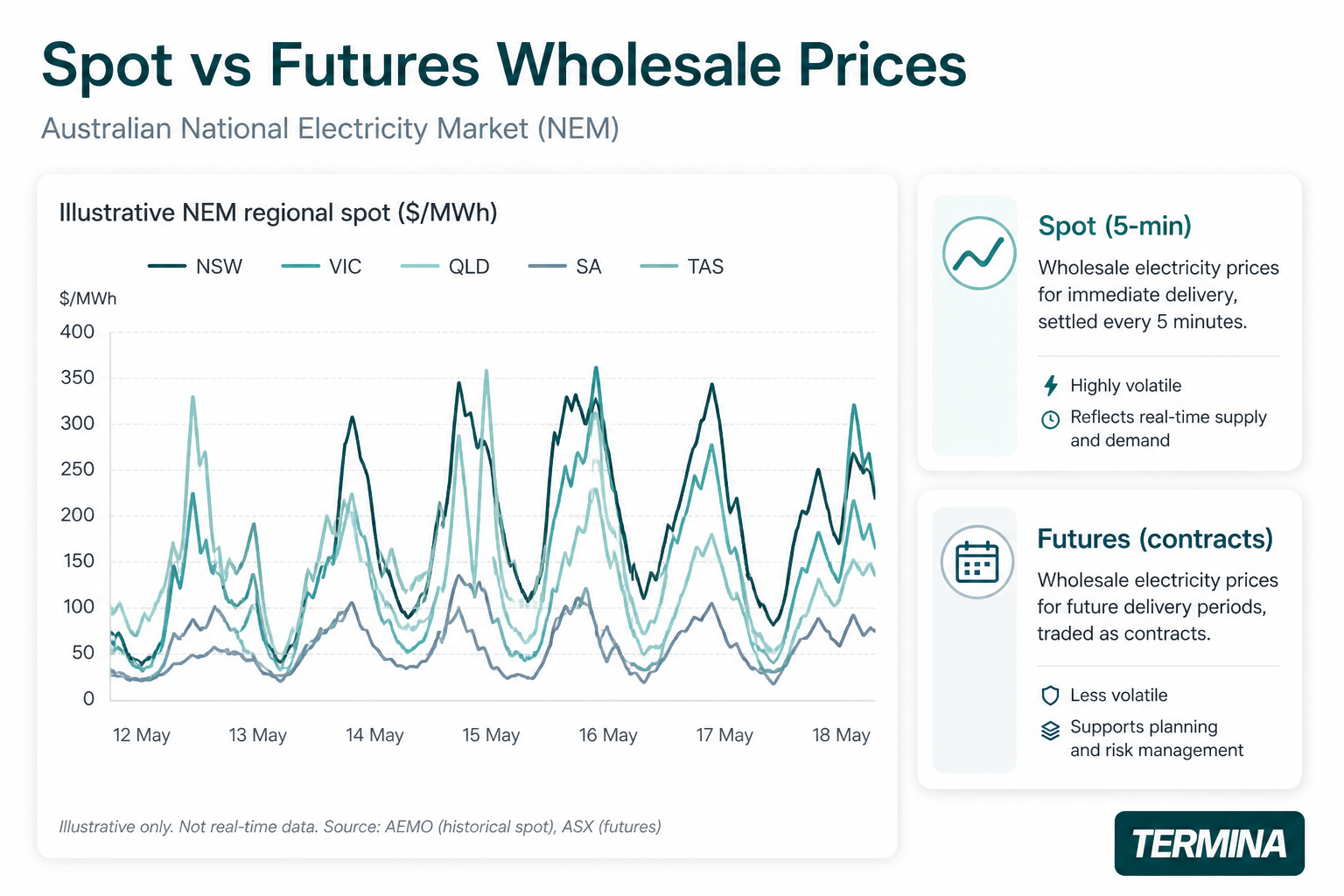
Spot prices are the near-real-time wholesale clearing prices in each NEM region. Futures (contract) prices reflect what the market expects future spot outcomes to average, and they are a key input when retailers price fixed or structured commercial deals. Leading Edge Energy summarises this spot-versus-futures split for commercial buyers.
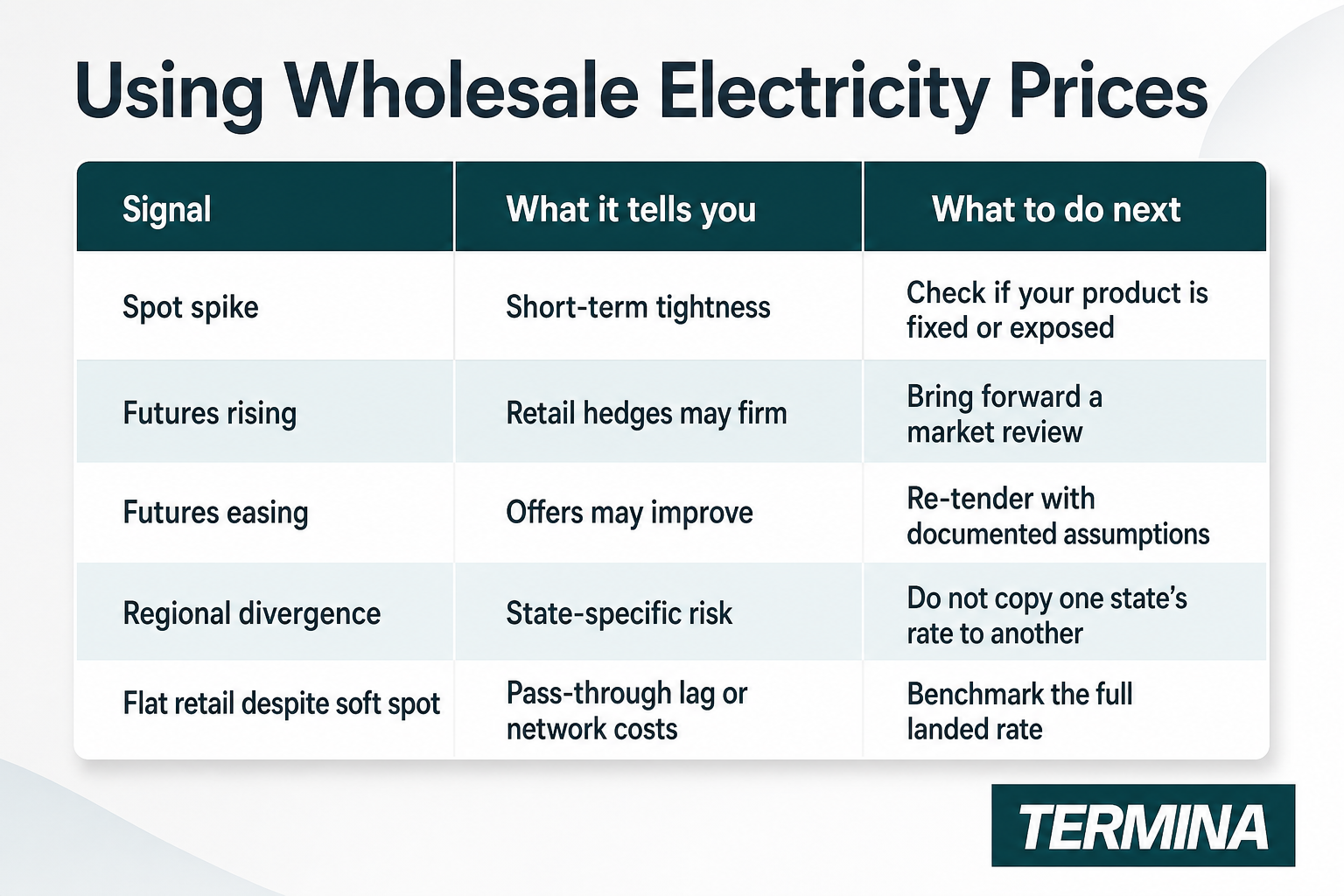
Contract markets, including products referenced on ASX Energy, help retailers and large customers manage risk. When futures rise, new retail offers often firm higher even if today’s spot looks calm. When futures ease, competitive tenders can improve, subject to network and other pass-through costs.
What drives wholesale electricity prices?
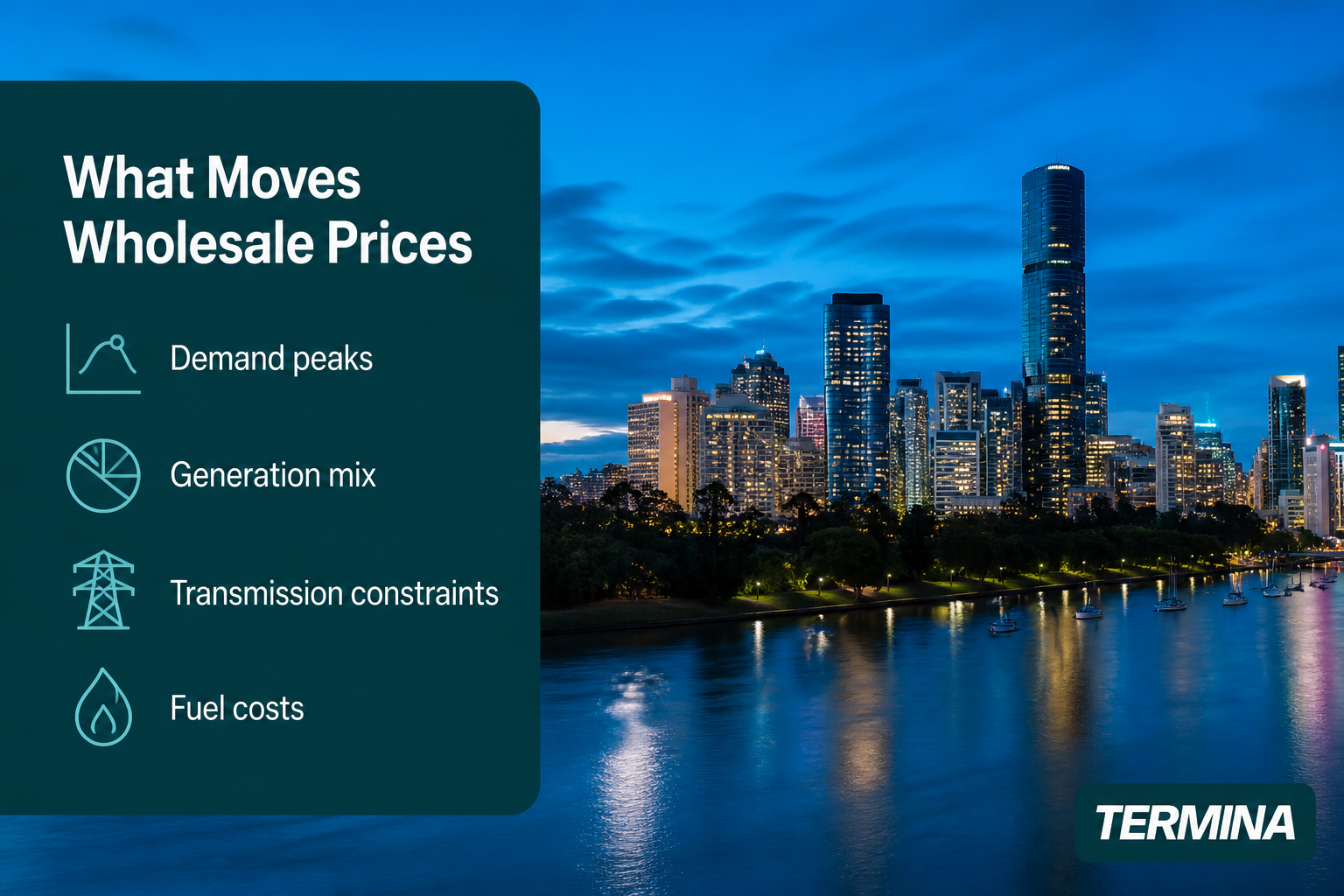
Wholesale prices move with demand peaks, available generation, fuel costs, renewable output, outages, transmission constraints and weather. Tight supply or high evening demand can spike spot. High renewable generation in mild conditions can push prices lower, sometimes including negative intervals when generation exceeds demand.
Regional differences matter. NSW, Victoria, Queensland, South Australia and Tasmania can diverge on the same day because of interconnectors and local plant. Treat any single-day spike as a signal to investigate, not as your long-term retail rate.
How do wholesale electricity prices affect business retail bills?
Retail contracts pass through wholesale risk in different ways. Fixed-rate deals lock a retailer hedge into your unit rate for a period. Variable or market-linked products leave more wholesale movement in the bill. Large C&I sites may use more sophisticated hedges; smaller sites usually buy a packaged plan.
Even when wholesale falls, your bill may not drop until you re-tender or your benefit period ends. Network charges and other regulated components can offset wholesale relief. That is why ongoing comparison beats a one-off screenshot of the AEMO dashboard.
How should businesses use wholesale electricity prices when buying?
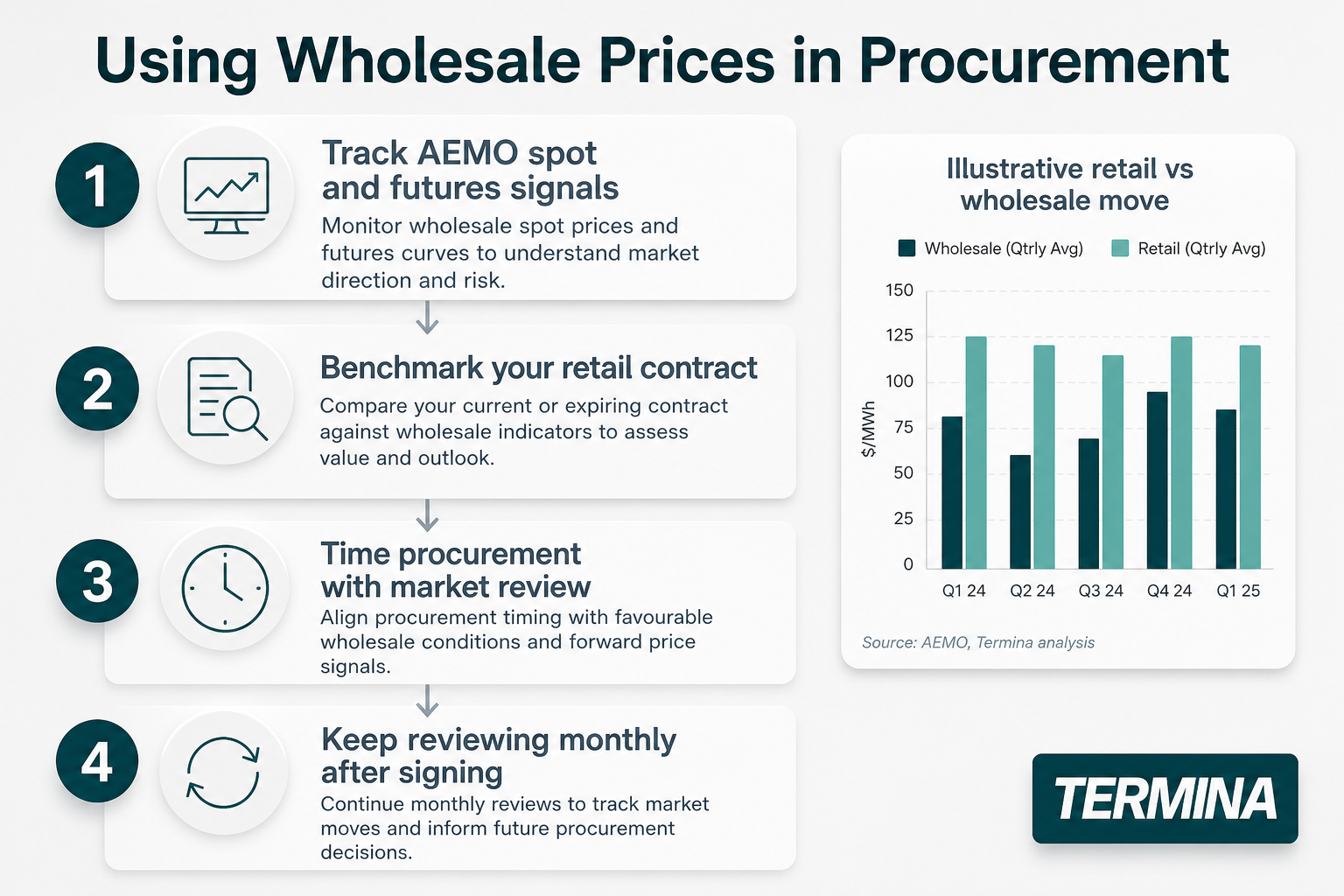
Use wholesale data as timing and risk context, then validate every offer against your interval data and 12 months of bills. Compare at least two independent views (for example AEMO plus a broker or platform tender) before you sign. Past wholesale averages are not a forecast of your next invoice.
Termina monitors retailer markets for commercial portfolios, consolidates multi-site data, and states on pricing that it refuses retailer commissions and earns from a share of documented savings when procurement runs. Choice Energy and other C&I brokers are fair alternatives some buyers also shortlist. Neither path guarantees savings on every site.
Why use Termina when wholesale electricity prices are moving?
Termina is built for commercial and multi-site buyers in Australia and New Zealand who need wholesale-aware procurement without doing daily trading themselves. Pair dashboard visibility with commission-free tenders and monthly review so you are not locked into yesterday’s hedge story until the next renewal panic.
- Pull live context from AEMO’s NEM dashboard
- Upload bills for a Termina savings estimate
- Compare full retail offers, not headline cents alone
- Keep reviewing after switch through Termina’s procurement model
Advisors can refer clients through Termina partners. Sector teams in retail, hospitality and manufacturing often mix wholesale timing with portfolio admin.
Frequently asked questions
Are wholesale electricity prices the same as my business tariff?
No. Wholesale is the generator-to-retailer (or large-user) market price. Your tariff adds network, environmental, metering and retail costs, and may be fixed for a term.
Where can I see current Australian wholesale prices?
For the NEM, start with the AEMO NEM data dashboard. WA uses the separate WEM framework. Contract pricing context is also discussed by market commentators and ASX Energy.
Do falling wholesale prices mean my bill will fall this month?
Not necessarily. If you are on a fixed retail contract, wholesale relief may only appear when you re-contract. Variable products and large hedges behave differently. Always check your contract type.
Should SMEs buy straight from the spot market?
Most SMEs buy packaged retail products rather than managing raw spot exposure. Spot trading suits participants set up for wholesale market rules and risk. If unsure, compare retail tenders first.
Can Termina guarantee savings when wholesale prices drop?
No. Termina can tender the retailer market and keep reviewing offers. Results depend on your load, contract timing, networks and retailer pricing. Historical portfolio outcomes are not a guarantee for your sites.
Who else explains wholesale markets for business buyers?
Independent operator data from AEMO is the primary source. Commercial explainers from Leading Edge Energy, Energy Action and Choice Energy can help with buyer education alongside a platform like Termina.
Get your Scope 1 and 2 data from your own bills
Your first 50 bills on the platform are free. Load a year of history and see whether it comes back clean.
x
x
x
x
x
x