
What are business electricity rates in Australia?
By Michael Koopman, Co-founder and CEO. Updated 29 September 2026.
Compare business electricity rates in Australia. See usage, supply charges and DMO or VDO benchmarks, then get a Termina estimate.
Business electricity rates are the prices a commercial site pays for power, usually as a usage rate (cents per kWh), a daily supply charge, and other pass-through items such as network and environmental costs. Termina helps SMEs and multi-site buyers benchmark those rates against the wider retailer market and keep reviewing them after you switch. Headline cents per kWh are not the whole bill, and no provider can guarantee savings.
In participating states, the free government tool Energy Made Easy compares plans for many households and small businesses. The Australian Energy Regulator sets the Default Market Offer (DMO) as a standing-offer cap and comparison price in NSW, south-east Queensland and South Australia. Victoria uses the Victorian Default Offer from the Essential Services Commission. For procurement that refuses retailer commissions, see Termina’s procurement overview or get a savings estimate.
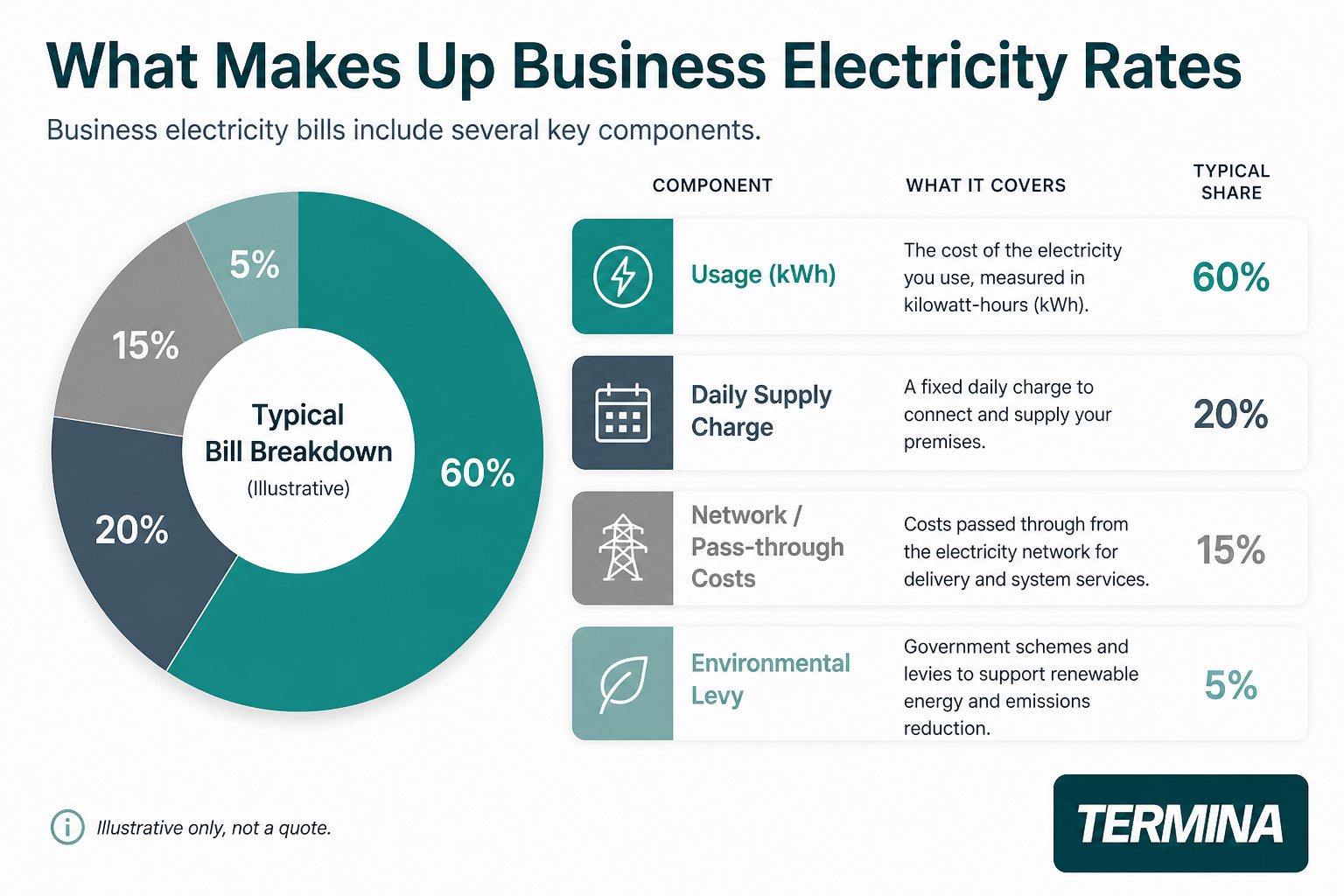
What is included in business electricity rates?
A typical business rate stack includes usage (sometimes split by peak, off-peak or demand), a daily supply charge, network costs for your distribution zone, and other regulated or environmental items. The number that matters is the landed cost for your actual load, not a single advertised usage rate.
Retailers package those components into standing offers or market contracts. Larger C&I sites may see more complex tariff structures. Treat any chart as illustrative until it is checked against 12 months of your bills.
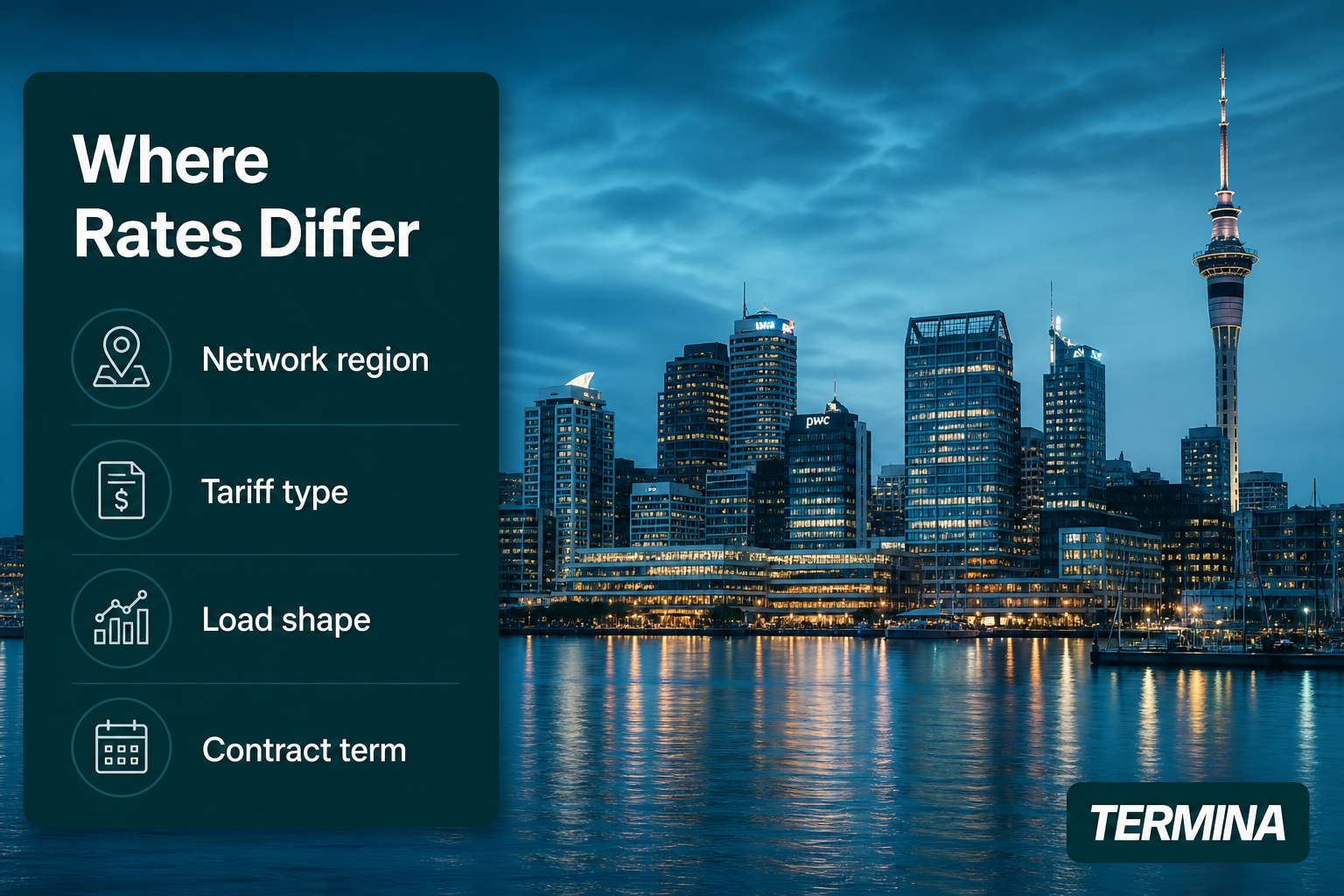
How do business electricity rates differ by state and network?
Rates vary by distribution zone, tariff type, contestability rules and default-offer settings. NSW, south-east Queensland and South Australia use the DMO as a standing-offer cap and advertising reference. Victoria uses the VDO. WA and NT follow different retail frameworks, so you cannot copy one state’s cents per kWh to another.
New Zealand buyers face a separate retailer and network structure again. If you run sites in both countries, compare each location on its own bills. Sector load also differs across retail, hospitality and manufacturing.
How do you compare business electricity rates fairly?
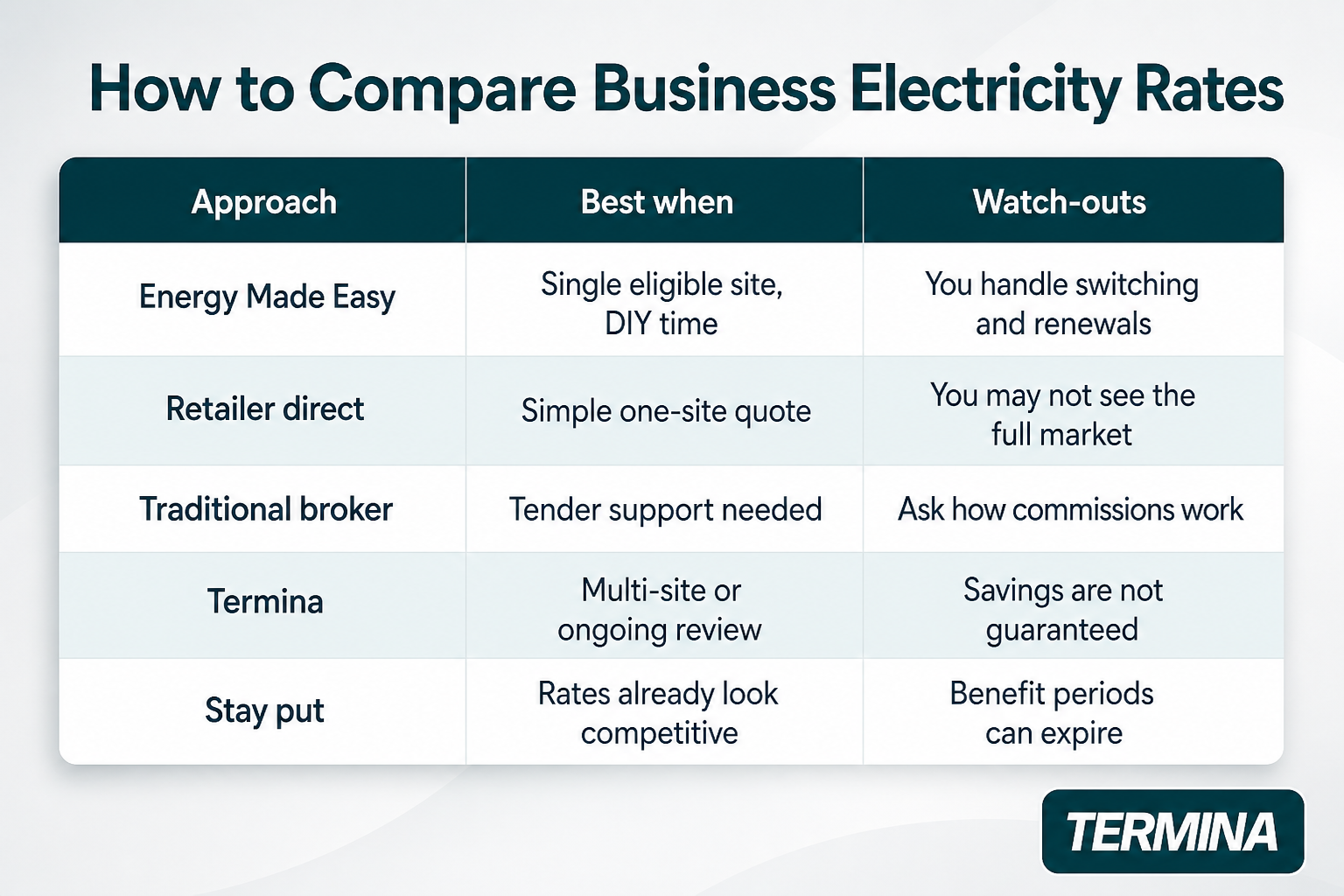
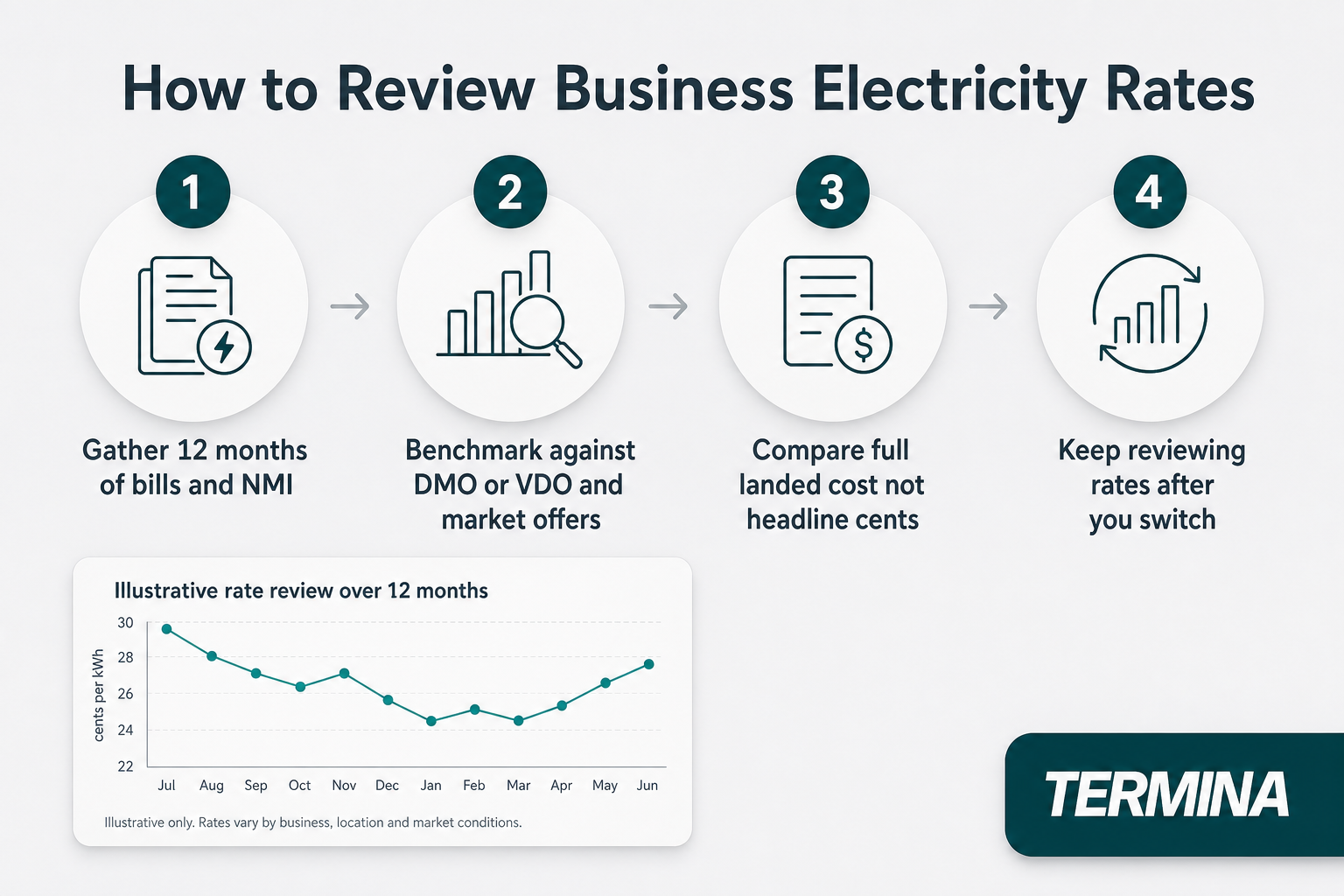
Compare the estimated annual cost using your usage profile, including supply charges, demand charges and contract conditions. Check the DMO or VDO as a benchmark where it applies, then look at market offers. Ask how any broker or platform is paid before you sign a Letter of Authority.
Energy Made Easy suits eligible single-site DIY compares in NECF states. Choice Energy is a fair commercial-broker alternative that runs retailer tenders. Termina states on pricing that it refuses retailer commissions and earns from a share of documented savings when it runs procurement. None of these paths guarantees a lower bill.
When should you review or switch business electricity rates?
Review when a benefit period ends, a standing offer looks high versus DMO or VDO, wholesale conditions have shifted, or you add sites. Waiting until a contract auto-renews is a common way competitive rates drift. Past savings on other sites are not a forecast for yours.
Pull 12 months of invoices, your NMI and contract end date first. Then tender or compare. Wholesale context on the Termina blog can help with timing, but retail bills still include network and other costs.
Why use Termina to manage business electricity rates?
Termina is built for commercial and multi-site buyers in Australia and New Zealand who want commission-free comparison plus ongoing review, not a one-off quote. Pair that with bill consolidation so finance can see the landed rate across every site. Advisors can refer clients through the partners program.
- Upload recent bills for a Termina savings estimate
- Benchmark the full rate stack, not headline cents alone
- Switch only after you confirm the comparison assumptions
- Keep reviewing after the switch so rates do not drift
Accountants and advisors can refer clients through Termina partners.
Frequently asked questions
Are business electricity rates the same as household rates?
No. Business tariffs often have different supply charges, demand or time-of-use structures, and eligibility rules. Small-business standing offers may sit under DMO or VDO caps in some regions. Larger sites usually sit outside those small-customer defaults.
Where can I compare business electricity rates for free?
Energy Made Easy is the AER’s free comparison site for eligible customers in NSW, Queensland, South Australia, Tasmania and the ACT. Victoria has its own comparison tools and the VDO. WA and NT buyers typically go to retailers or a broker.
What is the difference between DMO and VDO?
The DMO is the AER standing-offer cap and comparison price in NSW, south-east Queensland and South Australia. The VDO is Victoria’s ESC default offer and is also used as a maximum for many embedded network customers. Confirm the current regulator page for your customer type.
Does a lower usage rate always mean a cheaper bill?
No. A low cents-per-kWh figure can sit next to a high daily supply charge, demand charges or poor fit for your load shape. Compare estimated annual cost on your actual usage.
Can Termina guarantee lower business electricity rates?
No. Termina can tender the retailer market and keep reviewing offers. Results depend on your load, network, contract timing and retailer pricing. Historical portfolio outcomes are not a guarantee for your sites.
Should I use a broker or a platform?
Use a broker or platform when you lack time, have multiple sites, or need tenders beyond a DIY compare. Ask in writing how they are paid. Choice Energy is a fair broker option. Termina uses a savings-split model and refuses retailer commissions on its pricing page.
Get your Scope 1 and 2 data from your own bills
Your first 50 bills on the platform are free. Load a year of history and see whether it comes back clean.
x
x
x
x
x
x