
How does multi-site energy management work in Australia?
By Michael Koopman, Co-founder and CEO. Updated 29 September 2026.
Multi-site operators in Australia lose margin when each location renews on a different date with a different retailer. This guide explains how to centralise bills, equipment costs, procurement, and reporting across a portfolio, what to onboard first, and when to move beyond site-by-site brokers. Termina combines portfolio dashboards, bill validation, and monthly market review for retail, hospitality, and manufacturing groups. Outcomes vary by portfolio and are not guaranteed.
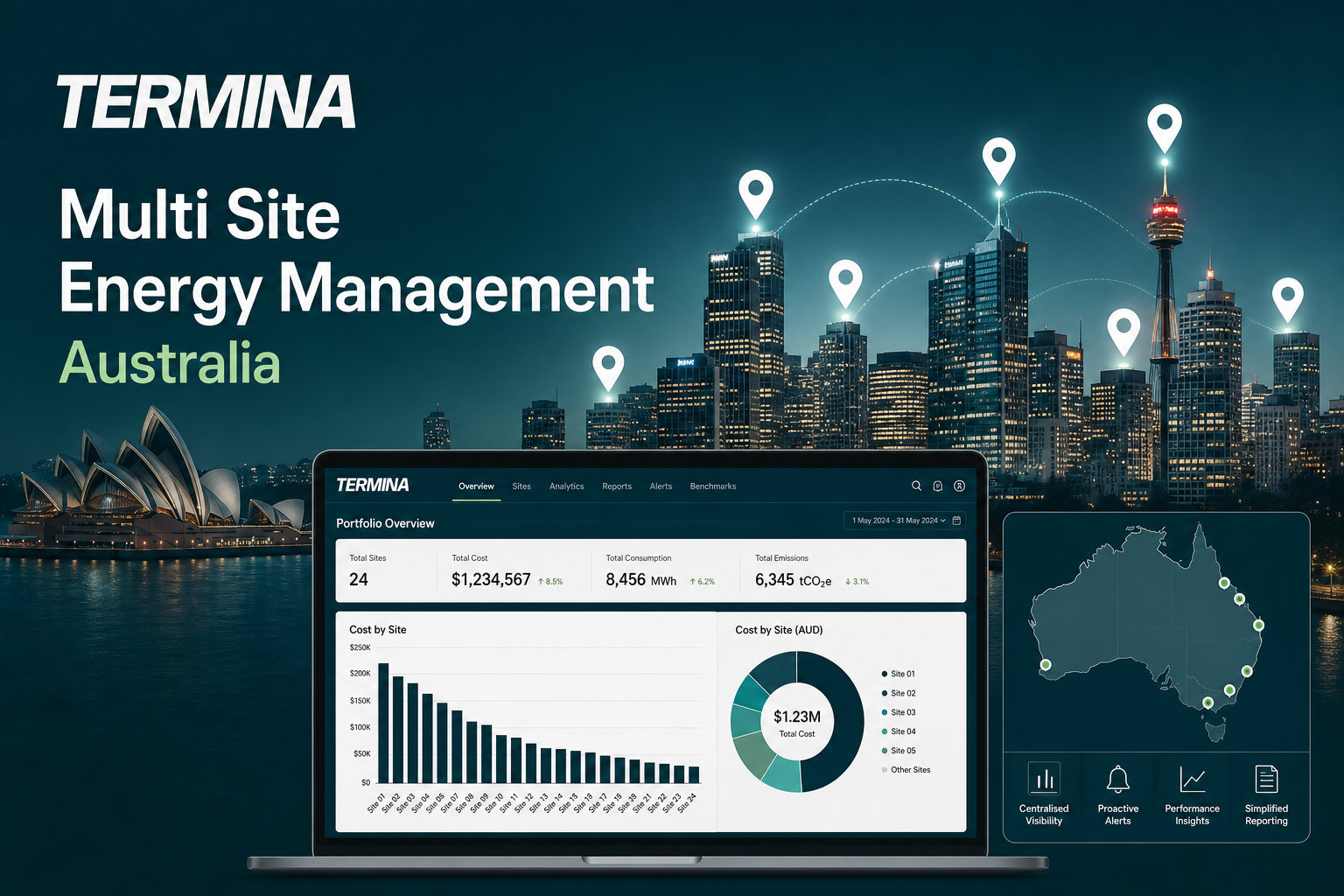
Multi-site energy management in Australia means consolidating bills, contracts, usage, and equipment costs across every NMI in one portfolio view, then reviewing rates and performance monthly rather than site by site. Termina combines portfolio dashboards, equipment cost tracking, bill validation, and procurement for retail, hospitality, and manufacturing groups. Outcomes vary by portfolio and are not guaranteed.
Spreadsheets fail when each store uses a different retailer, tariff, or renewal date. Start with commercial procurement, review pricing, or get a free savings estimate. The Australian Energy Market Operator publishes market and network context that affects pass-through charges on commercial bills nationwide.
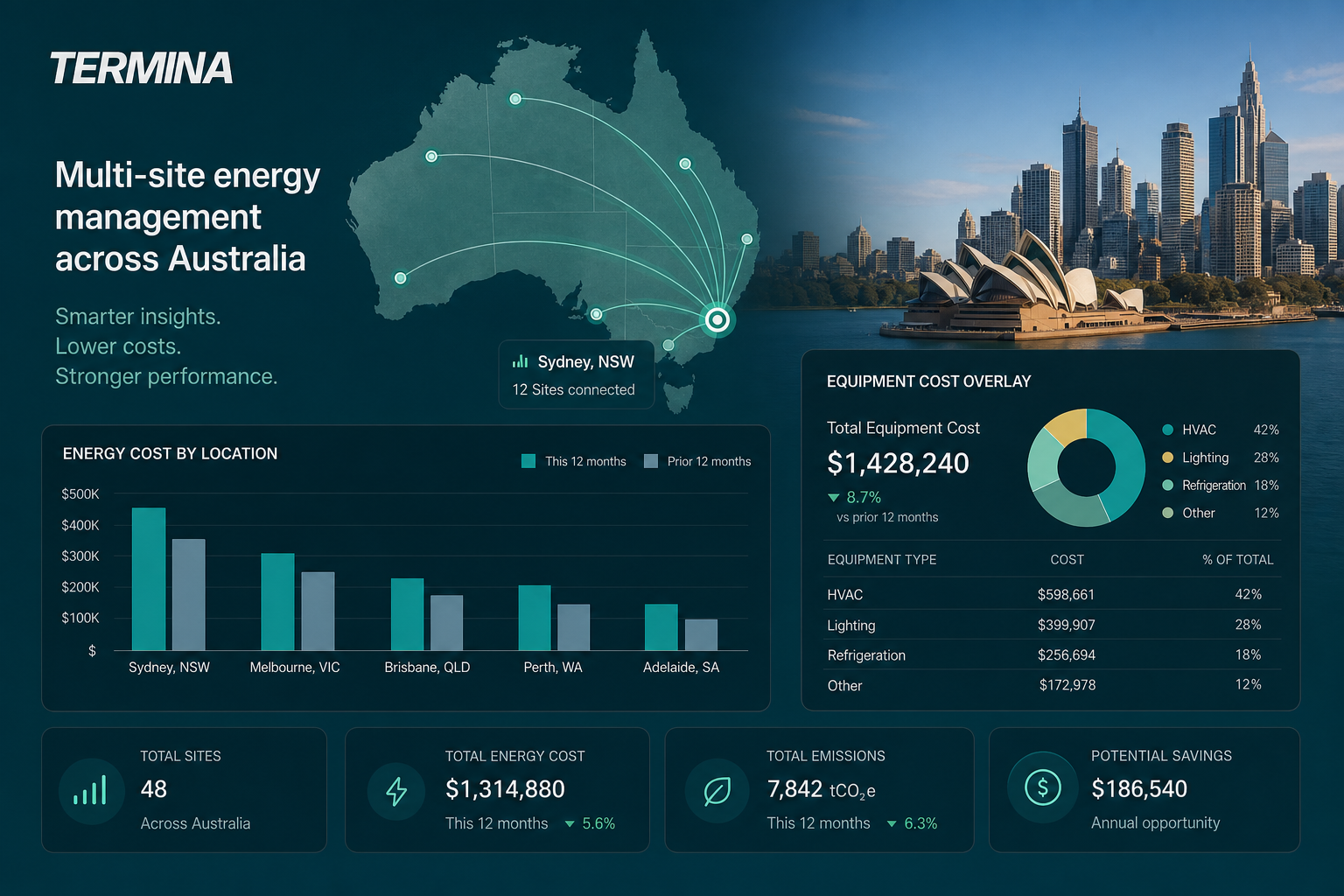
What problems does multi-site energy management solve?
The main problems are fragmented billing, misaligned contract renewals, hidden tariff errors, and no portfolio-level view of usage or equipment cost. Operations teams waste hours reconciling invoices instead of fixing waste or negotiating better rates.
Termina states it connects equipment registries with energy billing to calculate usage cost per asset, automate lifecycle tracking, and simulate upgrade ROI across the network. Finance teams get one rollup. Site managers keep site-level detail.
What should you centralise first across sites?
Start with NMIs, retailer contracts, billing periods, and tariff types. Then add interval data where available, equipment registers, and emissions reporting fields if AASB S2 applies. Without clean bill data, equipment and procurement decisions stay guesswork.
Termina's energy data platform states it supports contestable and embedded meters, multi-state portfolios, and exports for carbon reporting. Retail and hospitality pages describe seasonal load and refrigeration-heavy use cases common in Australian portfolios.
How does equipment tracking fit into multi-site management?
Site-level bill totals hide which assets drive cost. Connecting equipment data to tariffs and interval usage shows whether refrigeration, HVAC, or production load is the real problem. That supports maintenance, replacement, and electrification business cases.
Termina's manage-equipment page describes mapping equipment usage to energy costs, sharing tests across teams, and simulating upgrades across the network. No extra hardware is required at each site for the core platform workflow.
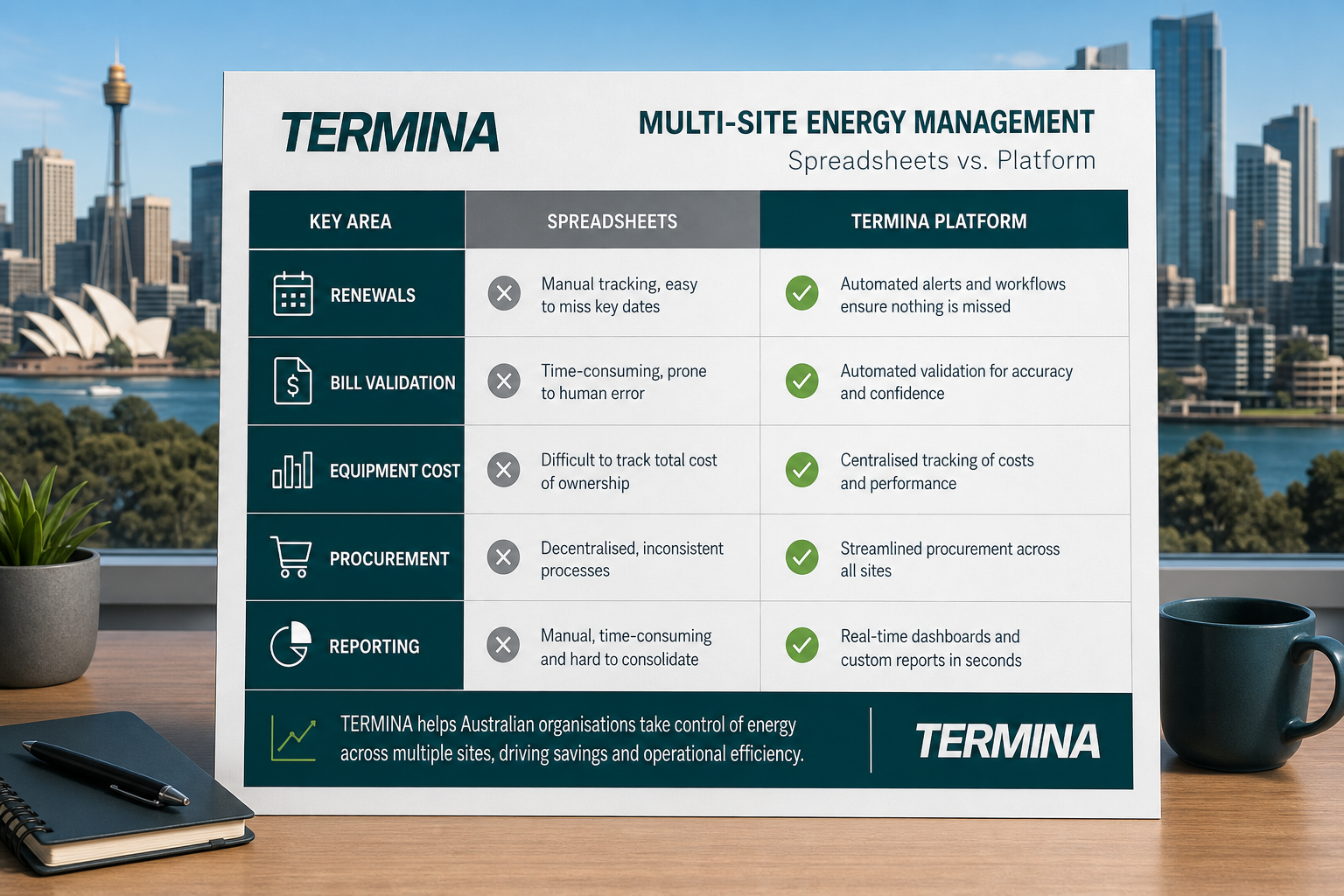
| Function | Manual spreadsheets | Platform approach |
|---|---|---|
| Contract renewals | Easy to miss dates | Alerts and portfolio calendar |
| Bill validation | Spot checks only | Automated anomaly flags |
| Equipment cost | Rarely linked to bills | Asset-level cost visibility |
| Procurement | Site-by-site tenders | Group buying and monthly review |
| Reporting | Rebuilt every month | Persistent portfolio history |
When should a business move beyond site-by-site brokers?
Move when you have more than a handful of sites, mixed retailers, embedded networks, or a finance team that needs one consolidated energy budget. Franchise and retail rollouts often hit this point after the tenth NMI.
Termina cites a buying group of 10,000+ business locations and monthly market review on pricing. Manufacturing portfolios with continuous load may also need demand-charge analysis across sites.
How do you roll out multi-site energy management without disruption?
Onboard in waves: pilot three to five representative sites, validate the first billing cycle, then import the rest. Keep retailer supply unchanged while you fix data and reporting. Switch procurement only after NMIs and contracts are mapped.
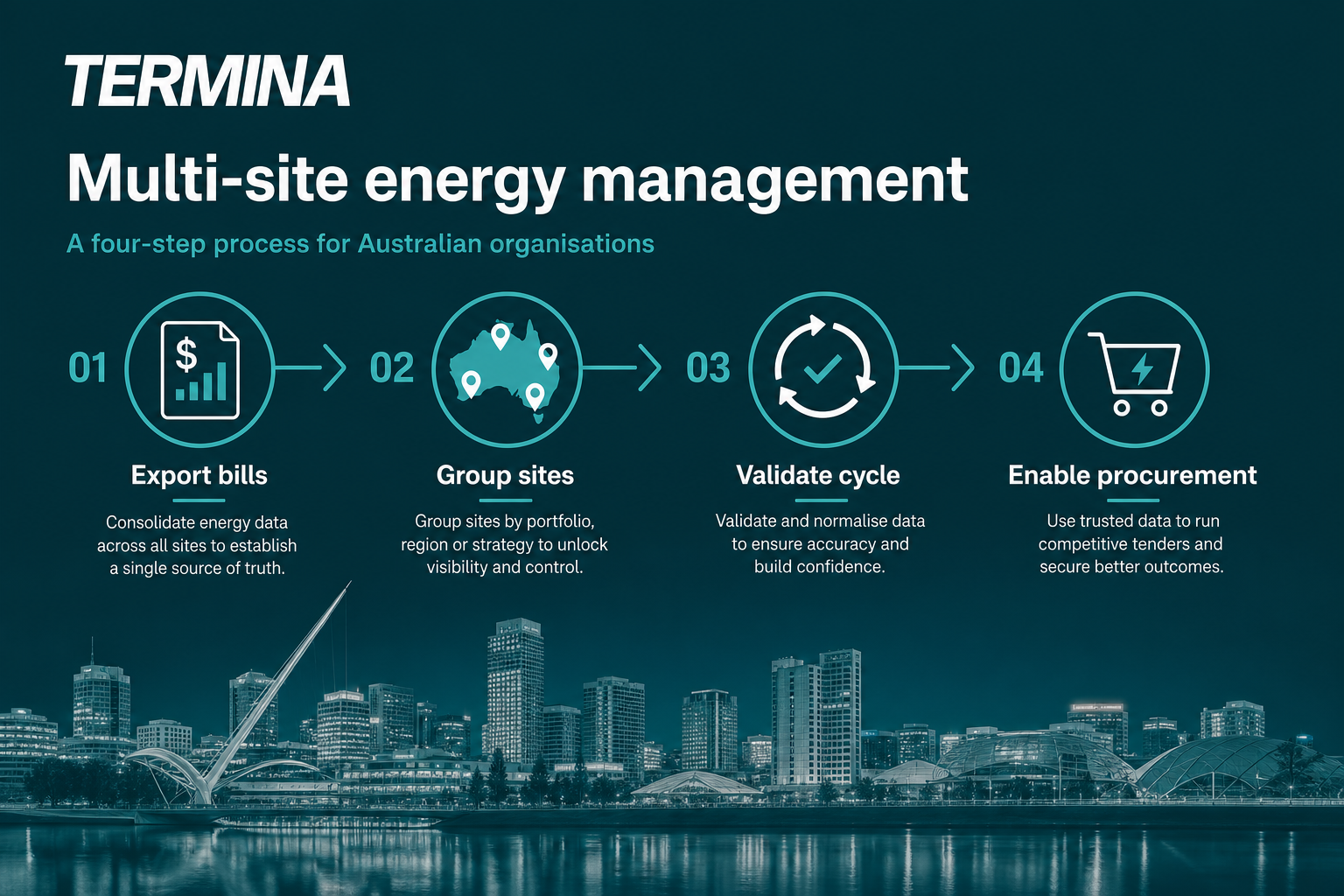
- Export bills and NMIs for every active site
- Group sites by brand, state, and tariff type
- Validate one full billing cycle in the platform
- Turn on procurement review or equipment tracking by priority sites
Partners can refer portfolio clients while Termina handles ongoing optimisation.
Frequently asked questions
How many sites do you need before multi-site management pays off?
There is no fixed number, but complexity usually spikes after five to ten sites or when renewals fall on different dates. Embedded networks and mixed retailers accelerate the need.
Can multi-site management work across states?
Yes. Australian portfolios often span NSW, VIC, QLD, SA, and WA with different DNSPs and retailers. A platform should normalise data while preserving state-specific tariff detail.
Does Termina replace my facilities team?
No. It gives finance and operations shared visibility so facilities can focus on equipment performance rather than invoice archaeology.
Will retailer switches disrupt my sites?
No. Retailer changes do not interrupt physical supply. Termina states switches are administrative and supply continues on the same network.
Where should I start?
Upload recent bills for a savings estimate and review manage equipment if asset-level cost is a priority.
Get your Scope 1 and 2 data from your own bills
Your first 50 bills on the platform are free. Load a year of history and see whether it comes back clean.
x
x
x
x
x
x